

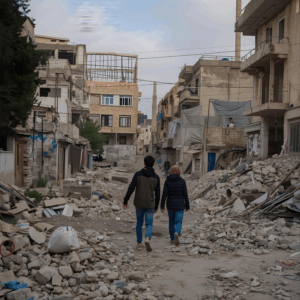
Going home doesn’t always mean going back. Sometimes, it means starting over, with less.
When Sara stepped off the bus into the ruins of her old hometown, she found what was left of her life reduced to rubble. Her house had no roof. Her land paper was gone. Her husband was missing, and her children had no documents to register for school. Though no longer a refugee on paper, she was not safe, not recognized, and not included. For her, and for millions like her, going home is not the end of displacement. It is the beginning of another kind of exile.
What happens when return doesn’t mean safety, but a new kind of uncertainty? When going home is not a solution, but a restart, with even less? Around the world, displaced people are returning to places still damaged by war. They are walking into legal limbo, broken services, and a tiring fight for basic dignity. And they are doing it mostly because they have no other choice.
Here’s the reality: for many, “returning home” means stepping into an empty space. Schools are closed. Clinics don’t work. Water is unsafe or hard to reach. IDs are missing, land is disputed, and homes are not livable. Government support is gone. Humanitarian aid, meant to be short-term, becomes the only help again. This isn’t a return to normal. It’s a return to weakness.
Yet in many policy reports and media stories, return is seen as a success, as proof that peace is working and people are “going back.” But calling return a solution hides a bigger problem: many returnees are no longer refugees, but they are far from full citizens. They live in the cracks between systems, struggling with the damage left by war, physical, legal, and emotional.
Sara’s story is not rare!
It represents a growing and often ignored crisis in post-war places. A new group of people is growing, the silent middle, who are neither displaced nor fully welcomed. They are no longer protected by international systems, but not yet supported by their governments. They are often ignored in policies, underfunded in programs, and invisible to donors. Without legal papers or access to basic services, they live in the shadows of rebuilding.
Around the world, returnees face three major challenges: missing documents, no basic services, and few job opportunities. Without IDs, they can’t access school or health care. Without land papers, they can’t claim their homes or rebuild. And without working local economies or government help, they must rely again on humanitarian aid. But this time, the aid is even less, because they are no longer counted as “displaced.”
This is not just a mistake in planning. It’s a real threat to human development and future peace. When returnees don’t get support, they risk being displaced again, or falling into deeper poverty and isolation. In these situations, progress on the global development goals becomes impossible. SDG 16; peace, justice, and strong systems, fails when people don’t have legal identity. SDGs 6 and 9; clean water, sanitation, and basic services, fall apart in places where nothing has been rebuilt. And goals about poverty, health, education, and equality can’t move forward when millions are left out of national recovery plans.
These goals are not just ideas. When they’re not met, it means families go without clean water, children miss years of school, and communities stay broken and unsafe. And when these gaps remain, they don’t just slow down recovery, they increase the risk of future conflict.
Syria is a clear and urgent example
According to UNHCR’s Regional Flash Update #41 (August 2025), over 821,000 Syrian refugees returned from nearby countries since December 2024. In the same time, more than 1.7 million people displaced inside Syria returned home, including 868,729 from camps and shelters. But many of these returns happened in places still damaged or destroyed. People didn’t return because it was safe. They returned because they had no other choice. On paper, they are no longer displaced. But in real life, they are still excluded, vulnerable, and invisible.
Legal limbo adds another level of difficulty. Proof of land ownership was often lost, or never existed. Without working courts, local services, or ID systems, returnees can’t prove who they are or where they belong. According to the Syria Returnee Rapid Assessment (May 2025), over 1.2 million people returned this year alone. But most still don’t have access to school, health care, or jobs. They are home, but not included.
UNHCR and its partners expect that up to 1.5 million Syrian refugees will return at the end of 2025. Their plans focus on fixing services and housing. But the funding tells a different story. While $575 million is needed to help these returnees, only $71 million has been promised. That’s less than 15% of what’s needed. This funding gap means families are returning to places with no help, no working systems, and no legal protection. It means hope is being met with silence, and systems that are not ready to support them.
These challenges are not just about missing services, they are built into the system itself. We must stop calling return a success just because people move. Instead, we must ask:
Are they safe? Do they have legal rights?
Can they access basic services and rebuild their lives? If the answer is no, then return is not complete.
If return is going to mean recovery, not just movement, then it must be planned and supported that way. Legal aid and civil papers must come first, to help families reclaim their identity and land. Rebuilding services is not a luxury, it’s basic dignity. Support for jobs must come along with housing. And returnees must be fully included in national development plans, with funding that meets their long-term needs.
Donors and aid workers must also recognize the risk of missing data. Without strong information on returnee conditions, we can’t plan support or track progress. We risk making policy based on silence, thinking no news means things are fine.
Yet, return should not be the end of humanitarian care. It should be its greatest test. Because if we don’t measure dignity, we risk losing it. And with it, the hope for peace.
Return is not the end of displacement, it is the test of everything we say we believe in. So the real question is:
Are we passing that test, or just pretending the exam is over?
